
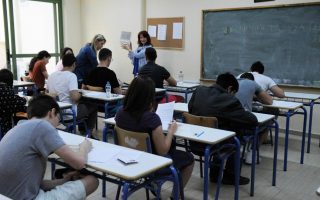
A new survey by the Institute for Educational Policy seeks to get to the bottom of why Greek school children consistently score poorly in the Program for International Student Assessment (PISA), a triennial survey conducted since 2000 by the Organization for Economic Cooperation and Development to evaluate education systems.
According to over 1,600 educators questioned for the study, which was seen by Kathimerini ahead of its publication, the biggest culprits are the educational system’s structure and culture (81.3%) and policy (75.8%). Not surprisingly, perhaps, the quality of teaching staff ranked as the least of the system’s problems, at 20.8%.
Moreover, six in 10 teachers are interested in making better use of PISA to improve educational standards, yet only one in four feels adequately informed. How can this be fixed? Over half of teachers say they want more training in the PISA framework, access to platforms featuring PISA-style questions and the enrichment of school textbooks with relevant examples.