
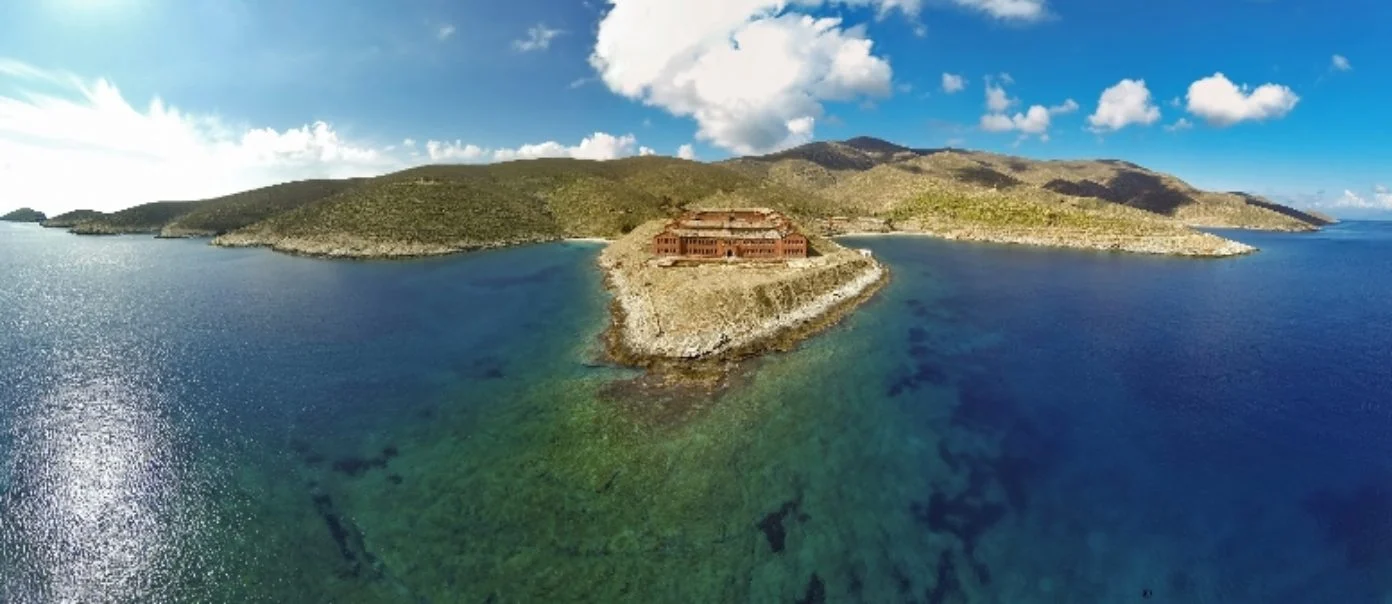
Once a grim place of exile and suffering during Greece’s military dictatorship, the arid and uninhabited island of Gyaros in the northern Cyclades is slowly transforming into a haven of nature and hope.
For more than a decade, WWF Hellas has led efforts to protect the island’s unique natural heritage through its “Cyclades Life” initiative. The absence of clear regulations had left the surrounding waters vulnerable to destructive activities such as trawler fishing and uncontrolled vessel anchoring, which threatened coral formations and vital Posidonia seagrass meadows.
“Gyaros is a unique place,” said Demetres Karavellas, CEO of WWF Hellas. “What was once a symbol of exile and death can now become a symbol of life and hope.”
A dark political past
Gyaros carries a heavy history. During the Greek Civil War (1946–1949) it served as a place of exile for political dissidents, including communists. Under the military junta (1967–1974) it continued as a site of political imprisonment, where women — some of them pregnant — were among those detained. Conditions on the island were often compared to those of a concentration camp.
A protected ecological treasure
Today the island is evolving into a protected ecological area and a potential destination for responsible diving. Designated a restricted zone and included in the Natura 2000 network in 2011, Gyaros was officially established as a marine protected area in the Cyclades by the Ministry of Environment in the summer of 2019.

How to visit Gyaros
Gyaros remains largely off-limits to casual tourism. There are no scheduled ferries, and private boats are not allowed to approach close to the shore without permission. Landing is permitted only at the single pier in front of the former prison buildings.
Organized group visits must be coordinated in advance with the Central Aegean Unit of OFYPEKA (Natural Environment and Climate Change Agency). Only day visits are allowed — camping or overnight stays are strictly prohibited. Visitors must stay on designated paths, bring their own water and food, and respect the sensitive ecological zones.
For most people, the easiest and most responsible way to experience the island is through the official Gyaros Story digital platform (website and offline app), which offers audio tours, historical material and virtual trails.
Looking ahead
Decades of isolation have allowed nature to reclaim the island. Mediterranean monk seals raise their young on its beaches, seabirds nest in its cliffs and burrows, and the surrounding waters host a rich marine ecosystem.
The long-term vision is to open Gyaros carefully to visitors while fully preserving both its historical character and its natural beauty. Legal complexities remain — the island was declared a historic monument in 2001, which prohibits any building activity — yet neighboring communities have expressed support for mild, sustainable forms of tourism.
Once a symbol of repression, Gyaros is steadily becoming an oasis of life in the Aegean.