
Greece rewards travelers willing to look past the classic postcard. With more than 6,000 islands and islets (only about 200 inhabited) and a mainland packed with ruins, gorges, and fortress towns, the country offers far more than Santorini sunsets and Mykonos beach clubs. The famous names still deliver, but several quieter destinations match their beauty with fewer crowds and better value.
This list balances both. Athens remains the natural gateway. Santorini and Mykonos live up to their reputations even as authorities manage cruise-ship numbers. Crete alone can fill a two-week trip. Meteora places monasteries on improbable rock pillars. Naxos and Milos offer classic Cycladic scenery without the premium price tags. The Peloponnese, centered on Nafplio, holds some of Greece’s best-preserved ancient sites. Rhodes contributes Europe’s largest inhabited medieval town. And Hydra, a car-free island just a short ferry from Athens, adds an elegant, low-key alternative that many first-time visitors overlook.
Ferries, budget flights, and solid infrastructure link almost all of them to Athens within a few hours. Here’s what makes each place worth visiting in 2026—and what first-timers should know.
Athens: The essential starting point
Athens is the practical hub for any Greek trip, and the Acropolis remains the country’s most iconic landmark. The Parthenon, completed in 438 BC, anchors the hilltop complex alongside the Erechtheion and its caryatid columns. The Acropolis Museum below displays finds from the site, including surviving Parthenon sculptures, and its glass floors reveal an excavated ancient neighborhood underneath.

Plaka’s pedestrian lanes and neoclassical houses wrap around the Acropolis slopes and sit a short walk from the ancient Agora. Athens also works as a base because of its connections: the airport links to Europe, the U.S., and Asia, while Piraeus port (a quick metro ride) runs ferries to nearly every inhabited island. You can land in the morning and be on a boat to the Cyclades or the Saronic Gulf by afternoon.
Beyond the classics, the National Archaeological Museum holds one of the world’s great collections of Greek antiquities. Neighborhoods such as Psiri and Metaxourgeio now pulse with restaurants and galleries. Summer temperatures often exceed 35°C, so reach the Acropolis at opening (around 8 a.m.). Spring and fall bring milder weather, shorter lines, and lower hotel rates than July and August.
Santorini: Caldera views born from catastrophe
Santorini’s dramatic cliffs exist because of a massive volcanic eruption around 1600 BC that collapsed the island’s center, leaving the crescent shape and sheer drop visitors photograph today. Oia and Fira perch on the caldera rim; Oia draws sunset crowds to its blue-domed churches, while Fira offers more restaurants, shops, and a cable car to the old port (or 588 steps or a donkey ride).
Akrotiri, on the southern coast, preserves a Bronze Age Minoan town buried by the same eruption—often called the Minoan Pompeii. A roofed walkway lets visitors explore multi-story buildings and streets frozen more than 3,000 years ago. Beaches reflect the volcanic geology: black sand at Perissa and Kamari, red sand at Red Beach near Akrotiri.

Cruise-ship pressure has led authorities to limit daily arrivals after peak days once brought more than 15,000 passengers ashore. Overnight visitors and ferry arrivals usually experience a calmer island. May and October deliver the same views with far fewer people.
Crete: One island that can be an entire trip
Crete is Greece’s largest island and the only destination on this list that works as a complete vacation. Mountains, gorges, Minoan ruins, and beaches stretch across roughly 260 km. Treating it as a quick stop usually means choosing regions instead of seeing the whole picture.
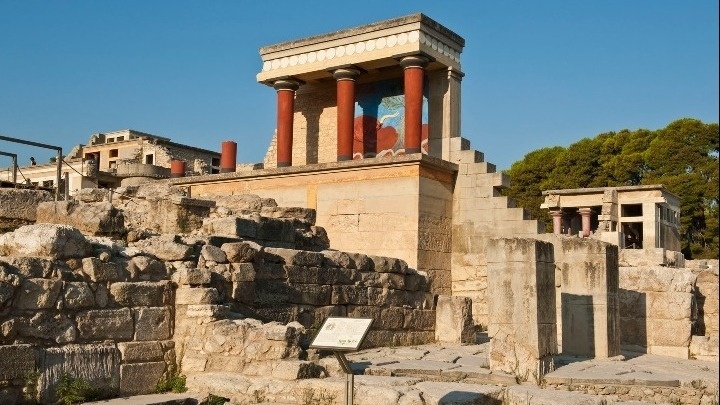
The Samaria Gorge in the White Mountains runs about 16 km and takes most hikers five to seven hours; it opens seasonally (typically May–October). Chania’s Venetian harbor and mixed architecture make its old town distinctive. Knossos, outside Heraklion, is the largest Bronze Age Minoan palace complex; Arthur Evans’s early-20th-century reconstructions and the site’s link to the Minotaur myth give it special clarity. Elafonissi’s shallow lagoon and pink-tinged sand (from crushed shells) sit under EU Natura 2000 protection.
Rental cars are relatively affordable, and distances between major sites range from 30 minutes to two hours. Local olive oil, cheese, and produce keep restaurant prices lower than on the Cyclades.
Meteora: Monasteries on stone pillars
Six active Eastern Orthodox monasteries sit atop sandstone pillars in central Greece. UNESCO listed the site in 1988 for both geology and architecture. The pillars formed roughly 60 million years ago; monks began settling the caves in the 11th century, with organized communities appearing in the 14th. The Great Meteoron is the largest and oldest of the survivors. Only six of the original 24 monasteries remain active (four with monks, two with nuns). Holy Trinity Monastery, used in the James Bond film *For Your Eyes Only*, requires about 140 rock-cut steps.

Most visitors pick two or three monasteries rather than all six. Entry fees are modest and a dress code applies (long pants for men; covered shoulders and knees for women; wraps available for rent). Kalambaka and the village of Kastraki at the base make good bases. A direct train from Athens takes about 4.5 hours. Sunset viewpoints above Kastraki need no ticket.
Mykonos: Nightlife plus ancient Delos
Mykonos still delivers the nightlife and beach-club scene it’s famous for, but it also offers quieter architecture and easy access to one of the Aegean’s most important archaeological sites. Chora features 16th-century windmills and the waterfront district known as Little Venice. Paradise and Super Paradise beaches remain the club hubs; the north coast is quieter.

Delos, a short boat ride from the old port, is the mythological birthplace of Apollo and Artemis and holds extensive ruins, including the Terrace of the Lions (7th century BC). UNESCO listed it in 1990; overnight stays are forbidden, so visits are day trips of three to four hours.
Direct seasonal flights and ferries (2.5–5 hours from Piraeus) serve the island. Prices for hotels, food, and beach clubs run higher than most other places on this list. May, early June, and October are noticeably cheaper and less crowded than peak summer.
Naxos: Cycladic beauty at a gentler pace
Naxos is the largest Cycladic island and delivers whitewashed villages and blue water without Santorini or Mykonos prices or crowds. The Portara—a massive unfinished marble doorway on an islet off the harbor—is the sole remnant of a 6th-century BC temple to Apollo.

Naxos Town (Chora) climbs from the harbor into a 13th-century Venetian kastro. Inland mountain villages such as Halki (known for kitron liqueur) and marble-built Apiranthos add depth. Fertile farmland supports local potatoes and cheese that appear across Greece, so menus lean heavily on regional produce.
Western beaches range from the convenient Agios Prokopios and Agios Georgios to the wider, windier stretches at Plaka and Mikri Vigla that attract windsurfers. Ferries from Piraeus take 3.5–6 hours; direct links to Santorini and Mykonos make Naxos an easy addition to a Cyclades route.
Nafplio: Gateway to Peloponnese ruins
Nafplio was the first capital of modern Greece (1829–1834) and still shows it in its architecture and two fortresses. Palamidi, an 18th-century Venetian stronghold, sits high above town (857 steps or a road). Bourtzi occupies a tiny island in the harbor. The old town mixes Venetian, Ottoman, and neoclassical layers.

Epidaurus, about 30 km away, preserves a 4th-century BC theater whose acoustics still work without amplification—the Athens and Epidaurus Festival stages ancient drama there each summer. Mycenae, roughly 20 km north, was the center of the Mycenaean civilization (c. 1600–1100 BC); its Lion Gate (c. 1250 BC) is one of Europe’s oldest monumental sculptures. Gold finds from the site are in the National Archaeological Museum in Athens.
Nafplio is about two hours from Athens by car or bus, making a multi-day Peloponnese loop practical.
Rhodes: Europe’s largest inhabited medieval town
Rhodes Old Town is the largest continuously inhabited medieval city in Europe, largely built by the Knights of St. John after 1309 and listed by UNESCO in 1988. The Palace of the Grand Master and the cobbled Street of the Knights form its core. The island’s name comes from the Colossus of Rhodes (c. 280 BC), one of the Seven Wonders of the Ancient World, toppled by an earthquake in 226 BC.

Lindos, about an hour from Rhodes Town, pairs a whitewashed village with an acropolis holding a 4th-century BC temple to Athena Lindia and sweeping bay views. East-coast beaches are generally calmer for swimming; the west side and Prasonisi at the southern tip draw windsurfers.
Direct summer flights and ferry links to other Dodecanese islands and Turkey’s Marmaris make Rhodes flexible. April–May and September–October offer warm weather with thinner crowds than July–August.
Milos: Otherworldly coastlines and quiet beaches
Milos is best known for Sarakiniko, where wind and sea have sculpted white volcanic rock into smooth, almost lunar formations—no sand or vegetation in sight. The island has more than 70 named beaches shaped by the same volcanic activity, ranging from white to black and multicolored sand.

A farmer found the Venus de Milo here in 1820; the original has been in the Louvre ever since, though the island’s archaeological museum in Plaka displays a cast. Klima’s colorful syrmata (boathouses with living quarters above) and Plaka’s hilltop Venetian castle ruins and sunset views add character. Mining still shapes the pale cliffs that color some beaches.
High-speed ferries from Piraeus take about 3.5 hours (conventional ferries up to 7). Direct links to Santorini make Milos easy to combine with a longer Cyclades itinerary. It draws fewer visitors than Santorini or Mykonos, which shows in the calmer beaches, restaurants, and prices.
Hydra: Car-free elegance just off Athens
Hydra sits in the Saronic Gulf, only 1.5–2 hours by high-speed ferry from Piraeus, yet it feels a world away from the mainland. The island bans all motorized vehicles—no cars, no scooters—leaving the steep stone streets to pedestrians, donkeys, and water taxis. The main town rises in tiers around a perfect horseshoe harbor lined with 18th- and 19th-century stone mansions built by wealthy ship captains. Strict building rules have preserved its elegant, low-rise character.

Visitors come for the atmosphere more than any single monument. Swim off the rocks or small pebble beaches, walk the coastal paths, visit the Lazaros Kountouriotis Historical Mansion, and eat excellent seafood right on the waterfront. Sunset from the hills above town is excellent, and the pace stays noticeably calmer than on the bigger Cyclades even in high season.
Hydra works equally well as a relaxed day trip from Athens or a multi-night base. Multiple daily ferries make logistics simple, and it pairs easily with other Saronic islands such as Spetses or Poros. Prices for lodging and food sit below Mykonos or Santorini levels, making it one of the more accessible “special” islands on this list.
These ten places cover the range Greece offers in 2026—from world-famous icons to quieter alternatives that still deliver dramatic landscapes, deep history, and excellent food. Book shoulder-season travel where possible, and you’ll find the country far more rewarding than the crowded postcard version.