
The IMEC trade corridor – India-Middle East Economic Corridor – has been increasingly promoted by the Greek and international media recently as a rival to the Chinese Belt and Road Initiative (BRI), which is already operational, transporting thousands of products from China to Europe every day.
Moreover, this was also the purpose of the group of states that supported the emergence of IMEC as a second trade artery between East and West, as evidenced by their signing of a Memorandum of Understanding (MoU) on September 9, 2023, in New Delhi, within the framework of a G20 meeting.
The group of states that signed the MoU in question, which included the USA, India, Saudi Arabia, UAE, France, Italy, Germany, and the EU, wanted to send a strong message to Beijing that in the economic competition between China and the West, there is room for the creation of counterweights, such as IMEC.
With India as a direct stakeholder and strong support from the US, the IMEC trade corridor is a grandiose undertaking with a central geostrategic goal of strengthening economic cooperation along its length. Regardless of whether IMEC can ultimately compete with the BRI on equal terms or develop it, it is certain to create a new business environment, boosting international trade and depriving China of some of the power and luster of the BRI.
This is why the US government has embraced IMEC, with President Donald Trump describing the project as “one of the greatest trade routes in history” during the visit of the Indian Prime Minister Narendra Modi in Washington.

However, despite the strong support of the American government, first at a political level and tomorrow at an economic level, the fluid geopolitical environment of recent months and the strong indications that no rapid de-escalation is foreseen on the current war fronts in the Middle East and Ukraine, raise reasonable questions about the requested acceleration of the project by the countries directly concerned.
In addition to India, which is the first to accelerate, the United Arab Emirates (UAE), Saudi Arabia, Jordan, and Israel are of direct interest, as their ports and railway terminals will be part of the IMEC route.
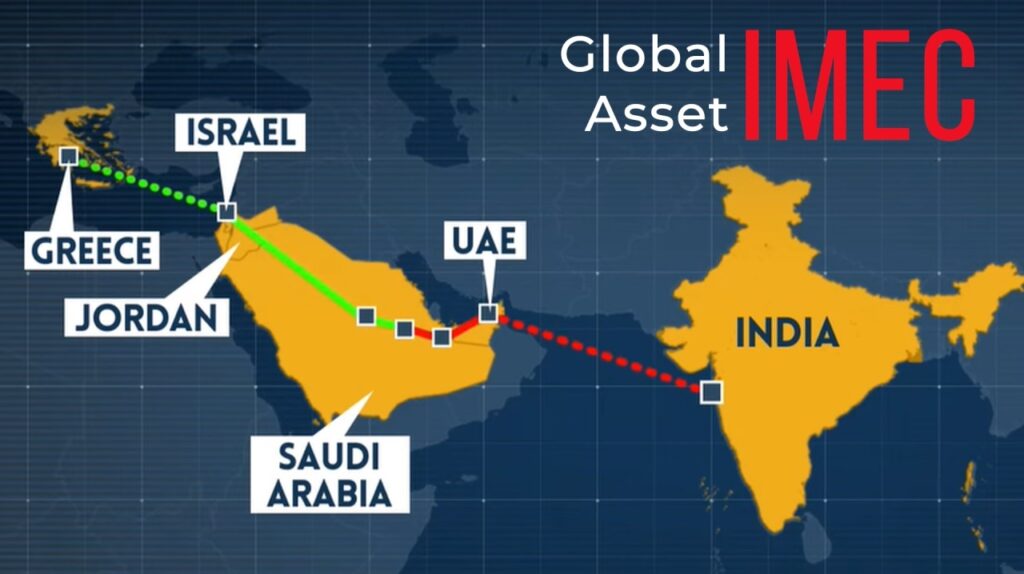
However, with Israel in a quasi-war situation in Gaza, Lebanon, and Syria and the conflict with Iran threatening to escalate the war in the region, the states involved are anything but ready and willing to promote their products for export to European destinations through the port of Haifa.
However, even if we assume that peace will come to the region relatively soon and work on implementing IMEC begins with the construction of new port facilities and a railway network, the development of the last leg of IMEC, which involves transporting products to Europe by sea, remains completely uncertain. However, it is in this leg of the complex IMEC route that Greece sees a role for itself to play.
As a senior executive of a large Greek company with interests in India observes, “Greece aspires to play a key role in IMEC, which it sees as an opportunity to build strong economic relations with India and the wealthy countries of the Persian Gulf, especially with Saudi Arabia and the UAE. Within this framework, initiatives such as the recent launch of the India-Greece-Cyprus Business Council (IGC) with Eurobank playing a central role, aiming to finance Indian investments in Greece and Cyprus, as well as Greek investments in India.”
However, despite the serious commercial ties developing between Greece and India and Greece’s crucial role in the maritime sector, since the large volume of IMEC’s goods will be transported by sea, there are serious objections from France and Italy, as well as from Indian business people, about how suitable Greece is for the promotion of goods through its ports to Southeast and Northern Europe. The first objection concerns the port of Piraeus, which is commercially controlled by the Chinese COSCO and has, therefore, already been excluded from IMEC’s strategic planning.
The ports of Thessaloniki and Alexandroupoli did not meet the conditions set by the designers of the new East-West trade route. These two ports qualify as auxiliary ports only due to their access to railway networks. Thus, according to sources, the large volume of goods that will move through IMEC will be promoted through the ports of Trieste and Genoa in Italy, as well as Marseille in France, with this solution prevailing as the most competitive at an economic and commercial level. This very mundane reality should ground the ambitions of the Greek government and the various collective bodies regarding the supposedly “key” role that Greece is destined to play in the organization and operation of IMEC.
READ MORE: USCIRF Recommends Turkey for Special Watch List Over Religious Freedom Violations.