
Lonely Planet Italia has placed Samos at the top of its recommendations for travellers who want nature, history, beaches and genuine island life without the crush that defines Greece’s most heavily marketed destinations.
The article, titled “Less crowded Greek islands for summer 2026: where to go beyond the usual destinations”, is not a scored ranking. It simply lists suggested islands in sequence. Samos opens the selection, followed by Lesbos, Chios, Samothraki, Alonissos and others.
What sets Samos apart, the guide argues, is a rare mix of green landscapes, hard-to-reach beaches, classical remains, mountain trails and a long wine-making tradition. The island is already known to international visitors, yet it has so far avoided the intensity of pressure seen on Santorini or Mykonos.
Beaches that still demand effort
Special mention is made of Mikro Seitani and Megalo Seitani on the north-western coast. Enclosed by cliffs, woodland and largely untouched terrain, these coves are reached mainly on foot or by sea. Even in high season they stay quieter than the more accessible organised beaches. The walk requires proper footwear, water and a realistic view of the weather. The lack of mass tourism here owes as much to the absence of roads, car parks and beach bars as to any deliberate exclusivity.
Lonely Planet also highlights Potami, one of the better-known beaches on the western side of the island, with its coarse pebbles, clear water, green hillsides and nearby waterfalls.
Mount Kerkis and the hill walks
Walkers are pointed towards Mount Kerkis, the 1,434-metre massif that dominates western Samos. Paths lead through pine forest, open slopes and small settlements, giving views across the island and the eastern Aegean. In the same area is the Cave of Pythagoras, linked by local tradition to the mathematician’s escape from the tyrant Polycrates. Historical certainty matters less than the path’s lasting popularity.
Summer hikers are advised to start early, carry water and a hat, keep a charged phone and leave details of their route. Even short walks can become risky in the heat.
Birthplace of Pythagoras, Hera and ancient engineering
Samos is the birthplace of Pythagoras and of the astronomer Aristarchus, who argued in antiquity that the Earth circles the Sun.
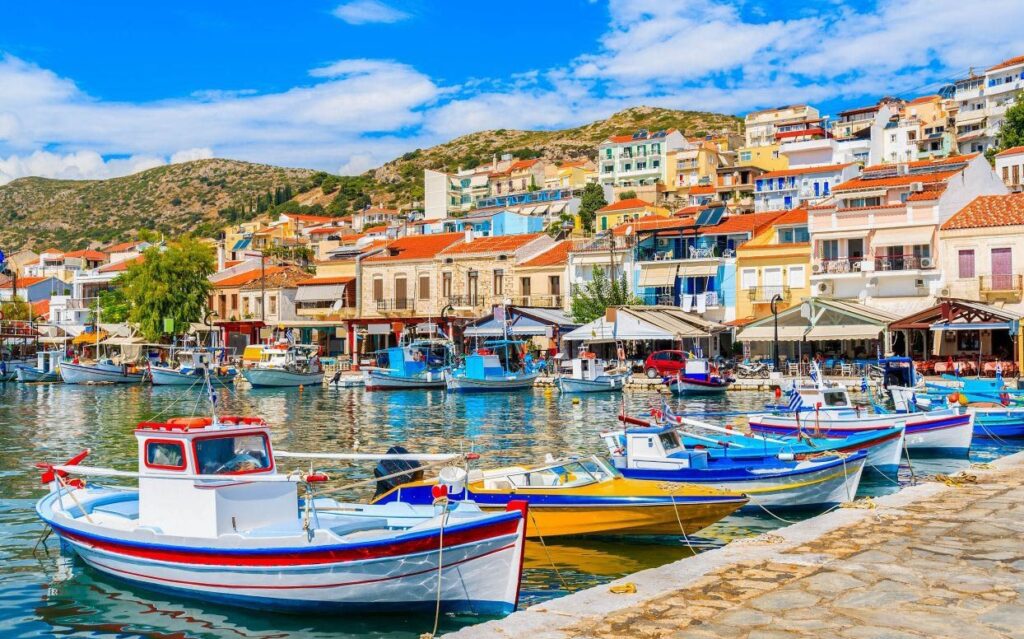
Its chief classical sites — the Heraion and the ancient city of Pythagoreion — form a single UNESCO World Heritage property. The most impressive engineering feat is the Eupalinian aqueduct, a sixth-century BC tunnel driven through the mountain from both ends with remarkable precision.
Wine as part of the experience
The guide also draws attention to Samos’s wine heritage. Mountain terraces are planted mainly with the small-berried white Muscat, used for both sweet and dry aromatic wines. Local estates offer tastings and an introduction to production methods that have long been part of the island’s international identity.
Why Samos is not yet another Mykonos
The island has an international airport, ferry connections and developed tourist facilities. Calling it secret or undiscovered would be an exaggeration. Yet visitors are spread across a relatively large territory rather than concentrated in one resort. Popular centres such as Pythagoreion, Kokkari and Vathy sit alongside mountain villages, smaller bays and quieter districts.
Local officials are deliberately promoting a sustainable model. Vangelis Marnezos, deputy mayor of West Samos for tourism, has said that the international attention confirms the value of the island’s natural beauty, cultural heritage, gastronomy and wine tradition. The municipality continues to host foreign journalists and to show both well-known sites and less-visited areas.
“We are steadily promoting the destination in the key international markets,” Marnezos said, “investing in a model of sustainable tourism development that creates value for visitors, the local community and future generations.”
For now Samos still offers what is becoming harder to find on Greece’s most celebrated islands: proper infrastructure without the feeling that the whole place has been turned into a stage set for one endless summer.