
A remarkable study of a vibrant Minoan fresco from the ancient settlement of Akrotiri on the island of Santorini is reshaping our understanding of Bronze Age globalization.
Buried for millennia under layers of volcanic ash from the massive Thera eruption around 1600 BCE, these well-preserved wall paintings are now revealing surprising connections between the sophisticated Aegean civilizations and distant lands as far as the Indian subcontinent.
The frescoes, often celebrated for their artistic mastery and naturalistic style, feature lively depictions of monkeys that have puzzled experts for decades. These exotic animals appear amid stylized landscapes, showcasing the Minoans’ advanced painting techniques and their fascination with the natural world.
Far from mere decoration, such artworks provide crucial clues about cultural exchange, economy, and exploration in one of the Mediterranean’s most influential early civilizations.
Background on the Minoans and Akrotiri
The Minoan civilization, centered on Crete but with outposts and influence across the Aegean, flourished from roughly 3000 to 1100 BCE.
Known for their grand palaces (like Knossos), sophisticated drainage systems, vibrant art, and maritime prowess, the Minoans were master traders and seafarers. Their ships connected Egypt, the Levant, Anatolia, and the Greek mainland, exchanging luxury goods such as pottery, metals, textiles, and exotic animals.

Akrotiri, often called the “Pompeii of the Aegean,” was a thriving coastal town on Santorini (ancient Thera). The site was buried in pumice and ash during a cataclysmic volcanic eruption, preserving multi-story buildings, frescoes, and everyday artifacts in exceptional condition.
Discovered in the 1960s and still under excavation, Akrotiri offers an unparalleled window into daily life during the Late Bronze Age. The famous “Blue Monkeys” fresco comes from Room 6 in the Beta Complex, where the animals are shown climbing, leaping, and interacting in a rocky, stylized environment.
Traditional Interpretation vs. New Evidence
For years, archaeologists linked the monkeys to African species, particularly baboons, due to established Egypt-Minoan trade routes. Egyptian records and artifacts show baboons imported from Punt as luxury items, status symbols, and even sacred animals associated with gods like Thoth.
This fit neatly with known diplomatic and commercial ties, including the exchange of ideas, technologies, and fauna.

The 2019 study in the journal Primates, however, turns this assumption on its head. Led by Dr. Marie Nicole Pareja, with contributions from primatologists Dr. Tracie McKinney (University of South Wales), Dr. Jessica Mayhew (Central Washington University), Dr. Joanna Setchell (Durham University), and taxonomic illustrator Stephen D. Nash, the research applies detailed comparative anatomy to the frescoes.
The Tail as Smoking Gun
The most compelling evidence lies in subtle but diagnostic features: elongated limbs, specific body proportions, facial characteristics, and especially the tails.
In the Akrotiri paintings, the monkeys’ tails arch into a distinctive raised “S” or question-mark shape when held aloft—a trait characteristic of grey langurs (genus Semnopithecus) from India and South Asia, but not typical of African baboons or vervets.
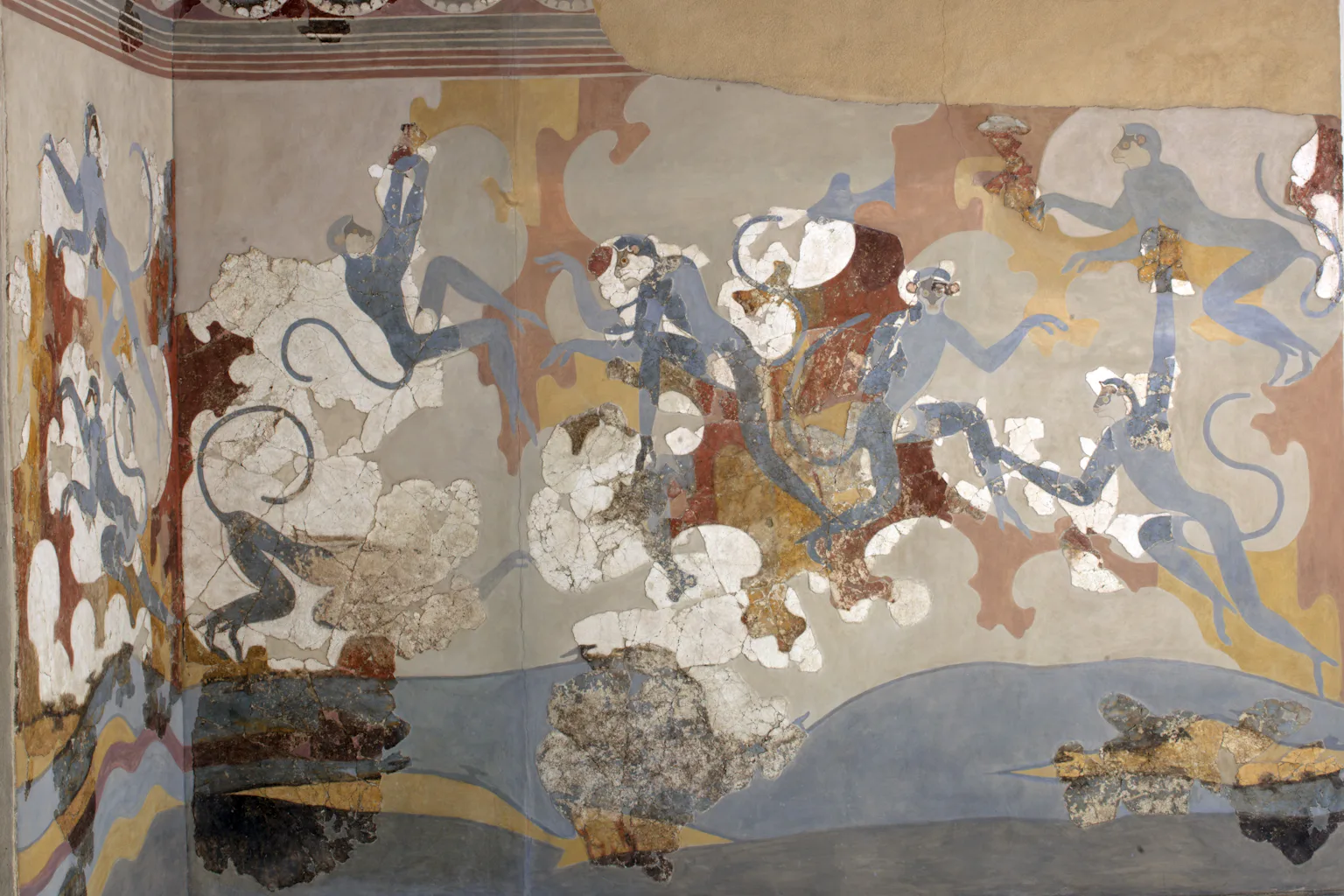
Langurs are slender, long-tailed primates known for their agility and presence in both wild and human-influenced landscapes across the Indian subcontinent. Their appearance in a Minoan context raises profound questions about the extent of Bronze Age networks.
Dr. Pareja emphasized the geographical implications in interviews: the distance from the Aegean to the Indus River is vastly greater than to Egypt, making direct or indirect contact “simply incredible” yet potentially transformative for our view of ancient connectivity.
Implications for Ancient Trade Networks
If accurate, this identification suggests a precursor to the famous Silk Road was active as early as the mid-second millennium BCE—roughly 1,500 years earlier than conventional timelines.
Goods, ideas, and possibly live animals could have traveled through multi-stage networks involving Mesopotamian city-states, the Indus Valley Civilization (known for its advanced urban planning, standardized weights, and maritime trade), and intermediaries in the Persian Gulf or overland routes.
Other exotic elements in Aegean art—such as depictions of lions, griffins, or foreign plants—support the broader picture of a highly interconnected world where luxury items and cultural motifs flowed across vast distances. High-value trade in spices, gemstones, ivory, and textiles would have incentivized such long-distance exchanges.
Academic Debate and Counterarguments
Not all experts are convinced. Critics including Bernardo Urbani (Venezuelan Institute for Scientific Research) and Dionysios Youlatos (Aristotle University of Thessaloniki) caution against over-interpreting stylized art.

They argue that Minoan painters employed artistic conventions and may not have aimed for photographic accuracy. The curved tails could result from artistic flair rather than precise observation of langurs.
Pareja’s team has responded in follow-up publications, defending their interdisciplinary approach. They highlight the frescoes’ overall anatomical fidelity, suggesting the artist(s) had direct experience with the animals—either through imported specimens or travel.
While no physical remains of Indian monkeys have yet been found in Aegean excavations, the cumulative iconographic evidence is compelling.
Why This Matters Today

This discovery underscores how much we still have to learn about the ancient world. The Minoans, once seen primarily as Mediterranean players, may have been part of far broader Eurasian networks.
Ongoing excavations at Akrotiri and related sites, combined with advances in archaeogenetics, isotopic analysis, and digital imaging, may yield further confirmation. For now, these playful blue monkeys on Santorini’s walls continue to leap across time, inviting us to reconsider the boundaries of the ancient world.
READ MORE: Deconstructing the Phoenician Myth: How a Linguistic Mix-Up Rewrote the Origins of the Greek Alphabet.